How to promote and secure engagement across the wider business teams
In our fast-moving digital landscape, businesses are compelled to innovate faster than ever to enhance brand engagement and meet the rapidly evolving needs of their customers.
New digital products, services, and systems are necessary, but only one-third of IT change initiatives are successful. How can you mitigate risk, secure investment, and reap long-term benefits from innovation in your business?
Aligning technical development with an effective brand engagement program is crucial for project success, as it helps understand the impact of innovations on teams and culture. Here, we’ll provide some tips on what to look out for.
Different groups of people’s receptivity and engagement with the new technological roll-out will vary for a variety of reasons, including:
Base level of brand engagement refers to one’s commitment to the team, organisation, strategy, and ways of working, which serves as the foundation for all subsequent actions. With exceptional brand engagement, you can introduce a variety of different variables while still achieving success. Low brand engagement leads to restricted reaction, regardless of technology preparedness. Employee satisfaction surveys can provide insight into an organisation’s baseline level of involvement.
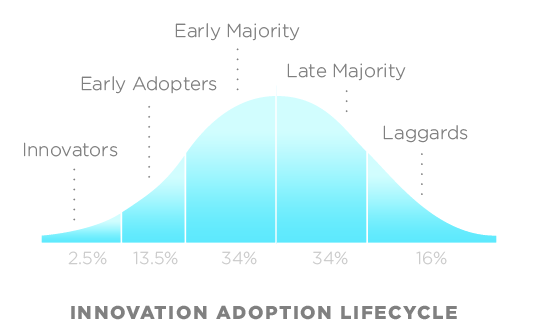
Openness to new technologies and desire to engage. Explained by the technology adoption lifecycle, or ‘Bell Curve’
‘Innovators’ and ‘early adopters’ want to be the first to use new technology, while ‘laggards’ are hesitant to switch, often due to a lack of alternatives.The “majority” refers to the 68% of employees who, to varied degrees, allow others in the firm to test and implement new procedures and modifications.
To gain traction for a new system, start with individuals who are more open to technology, such as creating a network of “champions” within the business.
What’s in it for me (WIIFM): people’s natural inclination to look out for themselves is the single biggest factor behind the majority of actions most people take everyday. At its most basic, we see are considering:
- What are the barriers? Is there any aspect of the new software or technology which is likely to cause risk, inefficiency or concern for any of our audiences? It could be they don’t feel like they have time to learn a new way of working for instance. We need to consider how we can answer such concerns up front.
- What are the incentives? What about the new technology is likely to win over the teams, will it save them time, will it report and integrate like never before, will it automate certain processes they’ve previously had to do manually? If we can isolate these benefits, we can ‘sell the sizzle’ to the various teams.
Imagine WIIFM is like a see-saw, with barriers on one end, incentives on the other – there is a trade off between these points and the side which has the most weight to it is what inspires or limits action respectively.
After considering these factors, how can we organise a successful software roll-out to increase brand engagement? After doing this numerous times, here are some tips we’ve learnt along the way:
- Build the right core team – ensuring your core team has the right mix of senior sponsorship, technical know-how and project management to deliver the right product, but also the right HR and Comms representation to ensure we consider how we best win over our various teams and audiences.
- Get insight – understanding more than the technical possibilities of what the new technology means rationally and emotionally for our audiences. We typically broach this through an efficient but representative sampling using a combination of interviews, focus groups and surveying.
- Campaign hard – The ‘internal’ environment of a large organisation is no less noisy than anywhere else; the many emails, feeds, meetings, newsletters can be overwhelming. Through leveraging the insight and getting seriously creative, build campaigns that will cut through, grab attention, and develop emotional connections. This lays the foundations for a consistent, memorable program that hooks into the memory of the audience and we can keep returning to, to stay more front of mind.
- Champions – Creating a network of engaged advocates across business divisions, sites, or functions can help build momentum for the launch. Champions, who are often more available to teams than head office, can be an excellent source of alignment and brand engagement.
- Start with the most relevant – In most technology rollouts, all employees are not equal because of the quantity or relevance of their usage. Placing more emphasis on those of have the most to gain (or lose) from the approach can play a big part in getting off to the right start. Positive experience then reinforces each other in a virtuous circle, as the initial audiences socialise their positive experiences across the business.
- Phase the approach – ‘You can’t eat an elephant whole’ as the saying goes. So instead, it can sometimes make a lot of sense to take ‘one bite at a time’ – gradually rolling out different features and functions gradually. Particularly for larger, more complicated systems, this helps teams to build and practice their knowledge, becoming more comfortable with the new ways of working.
- Offer training and clinics – Having a mixture of live and recorded training, an ability to re-sit sessions, access to help ‘clinics’ and champions on demand all go a long way towards engaging teams in understanding the finer points of the new software and making it work for them. Where there are multiple layers to the topic and sophistication of the audiences (e.g. for IT and development teams) and how they engage with the technology, mapping training pathways and driving clear visibility around this can yield significant value.
- Take a long-term view – Emphasis often gets disproportionally placed on the ‘big bag’ launch. Whilst it has its place, to be effective in the long run, we must allow for for an ongoing programme of onboarding, training, a drip feed of content, sharing case studies and best practice.
Introducing new technology to a business can be challenging, resulting in numerous stories of perceived failure online. By aligning insights and developing effective internal communications for different audience groups, we can increase brand engagement and achieve great results.
Do you have any questions on how you can use technology to improve brand engagement? Get in touch with the Clarity team, we’ll be happy to help!
For over 16 years, Clarity has been helping engage teams with new IT, technology and software initiatives. This includes:
- Helping the world’s second largest supermarket group with 300k+ to engage teams with information security and data governance, fostering a culture of awareness
- Supporting the UKs leading hotel brand with successfully introducing a new CRM system at 900+ hotels, driving adoption and new ways of working
- Helping a leading banking brand to launch its new IT training programmes and drive significant levels of opt-in
- Engaging automotive dealers with modern technologies to support the consistent selling of automotive finance
- Aiding one of the world’s largest engineering companies in delivering collaborative innovation events with key clients, building a spirit of partnership and synergy